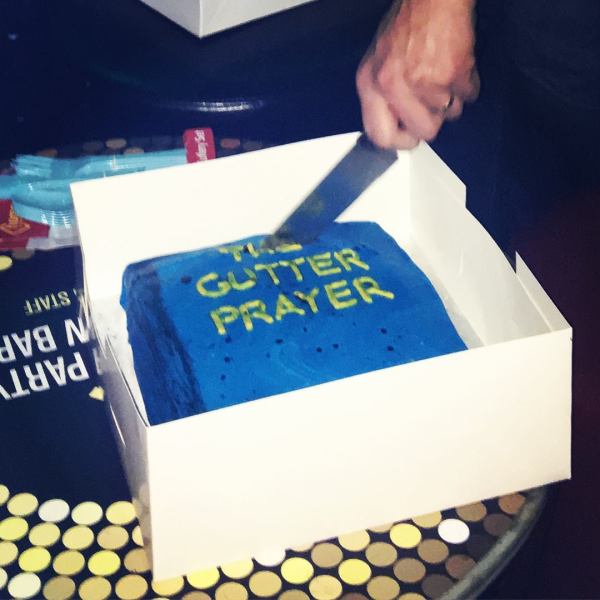
Warpcon Launch Party
The book is officially launched! Many thanks to all those who attended, many apologies to anyone who wanted a copy
The book is officially launched! Many thanks to all those who attended, many apologies to anyone who wanted a copy
Things are happening rather quickly now. The UK release date has come and gone, and the books are in the wild. The US release date impends (22nd Jan). Reviews come in waves, eddying back to pool in Goodreads or amazon. The response has been wonderfully positive, for which I am profoundly grateful. Upcoming events of note: 22nd January: United States release 26th January: Launch Party at Warpcon (5.30, probably in the New Bar.) 9th February: Signing at Waterstones Cork (3-5pm) In between all those things, I’ll be recording several podcasts, answering interviews, and racing to hit deadlines.
As a number of people correctly discerned (intuited? wildly guessed?), the cryptic text for the contest was from Robert Holdstock’s Lavondyss, one of my favourite books. Copies of The Gutter Prayer shall be dispatched as soon as possible. Winners (chosen randomly by die roll from the correct entries) are @_acupofcyanide, @RustyLeeMiller, and Beth of https://thebastardgods.com. We’re into the last week before release, so reviews have started coming quickly now. They’ve all been positive to one degree or another – some glowing, some more critical of parts. It’s taught me a greater appreciation of reviewing, and encouraged me to pay even less attention to the vagaries of the star system on goodreads! There have also been two print reviews – one in SciFiNow, and one in SFX magazine. I must grab print copies, but for now I’ll make do with scans… One week to go.
Copies of the signed Goldsboro books edition of The Gutter Prayer are in the wild, and reactions have been very gratifying so far. Mostly. Certain people – certain people known to me on a personal level, and whose names will be noted – have pointed out that my signature is (a) mostly illegible and (b) did not get visibly more illegible after I signed 700 copies. They have mocked my handwriting. Now, to be fair, my handwriting could be better. It tends to alternate between “childlike scrawl” and “prescription written by a doctor who you sort of suspect of self-prescribing painkillers”. It is… well, there’s a reason I type everything. But their mockery can be your gain. Now that I’ve got some spare author’s copies, I’m doing a little contest. Below, you’ll find a page from one of my favourite books, hand-written by yours truly. To enter, all you need to do is comment and name that book. Twitter messages also work. (If you don’t know
This isn’t right. This isn’t even wrong. – Wolfgang Pauli, allegedly Revisions continue. Over on Twitter, I said “are these the wrong words, or are they just in the wrong order?”, and I thought I’d quickly unpack this here. Revision and rewriting isn’t writing. By this point in the process, the book is fundamentally what it’s going to be. You can improve it, you can polish it, you can clarify it, you can remove crap bits or irrelevant bits, and – most valuable of all – you can look back at it and realise what you’ve written. You can’t, however, remake the book. Caveat – you can, but generally speaking, you shouldn’t. For example, I’ve got to deliver the revised Book 2 by the end of January. It’s theoretically possible, if I ignored every other commitment and deadline, I could write a totally different take on the original concept and deliver that instead, a page one rewrite – but that would be madness and
According to the Word of Word, I’m on page 238 of 653 (word pagination doesn’t match up with print pagination, by the way – Book 2 will be roughly the same length as Book 1). so, about two-fifths of the way through, right? Well… maybe. On the face of it, no – there’ll be more than one pass through. Right now, I’m in the middle of redrafting parts of the book. Taking out passages and subplots that don’t work, adding in replacements, cutting extraneous sections. There’ll be another pass of sanity-checking, another for style. So, if I’m going to go through the book another three or four times, then I’m only a fraction of the way through the revision process. Fortunately for me – and even more fortunately, for my deadlines – the really hard part is this first pass. Here’s when the book turns to sand and threatens to fall apart; here’s where I’ve got to hold all the
So, this is what 500+ copies of The Gutter Prayer looks like.
The edits for THE DIVINE MACHINE (or whatever book two will eventually be called – that’s another blog post for another day) have arrived. 680 manuscript pages, with one or two comments per page, plus an eight-page cover letter describing high-level problems with the story. My first piece of advice – take a day or two to read and absorb the edits before starting a rewrite. (You are permitted to weep openly, tear at your beard, rend garments, and cry out to the uncaring sky as appropriate during this time, if that’s part of your process.)
The official release date for The Gutter Prayer is January, of course, but it’s less than a month to go before the Goldsboro Books edition, and the release on Netgalley – and the advanced reading copies have gone out, too. I’m moderately sanguine about the whole affair on one level – this is not my first or even my hundredth rodeo – but there’s a vastly higher degree of identification in the case of a novel. Few people notice who wrote a particular rpg supplement; in general, people pay attention to game lines and publishing imprints, not authors, and most books have multiple writers involved anyway. Novels are a solo writing project, and my name (or some variation thereof) is right there on the cover. So, I am totally sanguine and nervously checking twitter every 30 seconds, because that’s a healthy way to be. There will be, by the by, an Official Launch Party at Warpcon. Details to be finalised, but expect some,
Or, in my case, the third. The Divine Machine wasn’t especially easy to write – the plot’s more complex than that of The Gutter Prayer, and there were some tangles that took a long time to unravel. However, the shape of it was clear, and more importantly – I had to do it. It was contracted. Now, I’m trying to work on something new. Starting something new is easy – the first few pages always flow, as you’re just putting words to a rough concept. After that, though, the thing has to run, it has to have momentum to go on for hundreds more pages, and that means pushing it along even as you slather more words on it. It’s all too common for the thing to fall apart, or start to look ugly and ill-formed and not worth it – especially when there are other pretty gossamer ideas flitting around freely, unshackled by the brick-dust of language. In short, words are
 Gareth Hanrahan